


Without being a professional Sommelier, opening a bottle of wine of a certain level in front of friends at a dinner party requires a few essential steps that anyone can put into practice.
First of all, start thinking that opening a wine is not a simple gesture that merely allows you to drink what you have purchased!
Opening a bottle of wine is in fact the culmination of a journey that began long before, made up of elbow grease, commitment, unexpected events, weather conditions, attention, and much more!
Therefore this operation must be carried out with care, both to present what you are about to drink to your guests in the most proper way, and out of respect for those who have worked so hard to make that wine available exactly as it is.
First, get yourself a corkscrew worthy of the name – so no double-lever corkscrews, but instead opt, without hesitation, for a tool of this type:
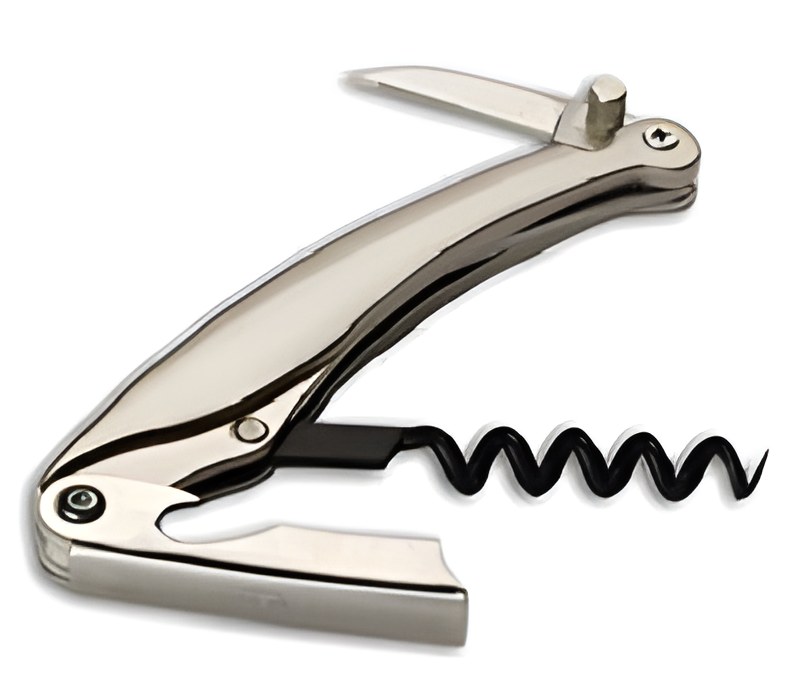
You can find it in all household goods stores, supermarkets, and wine shops – it replicates the Sommelier's instrument of choice.
With the label facing your guests and a relaxed air, use the small knife shown in the photo to cut, all the way around, the foil capsule protecting the cork.
At this point, direct the tip of the Teflon worm to the center of the cork and, holding the bottle steady with your other hand, screw in clockwise until the entire spiral has entered.
All that remains is to use the front part of the tool as a lever to pull out the cork.
Bring it to your nose and check whether the wine is corked.
It is not difficult to tell, because the smell – if there is a fault – is sharp, unpleasant, and reminiscent of rotten wood.
Pour a little wine into your glass and move on to a quick visual, olfactory, and taste analysis.
Remember that the wine must be clear to the eye when held up to the light and free of any suspicious particles in suspension; bear in mind that color shades are the result of a series of parameters including, for example, the grape variety, the method and duration of aging, and how the wine has been stored.
Good or bad are opinions, subjective judgements! These parameters therefore do not dictate the "correctness" of a product!
The taster should limit themselves to verifying that the color, aromas, and taste are consistent with the wine being tasted.
For aged wines, oxygenation is necessary in order to fully enjoy the wine's true aroma and flavor; for this type of product, pour the contents of the bottle into a decanter of this type and take care not to let the sediment fall into it.

If everything is in order, pour a moderate amount for all guests, starting with the eldest lady at the table.
For glasses, I would go with the classic tasting glass for young red wines

It can be used throughout the entire dinner and for all wines, including the aperitif, avoiding cluttering the table with glasses of various sizes.
For sparkling wines and young whites an ice bucket is a must, while I would use a soft wine sleeve cooler for a more full-bodied white on a particularly warm evening.

Enjoy your dinner and see you in the next issue of our guide!


What do you think?
Log in to leave a comment