


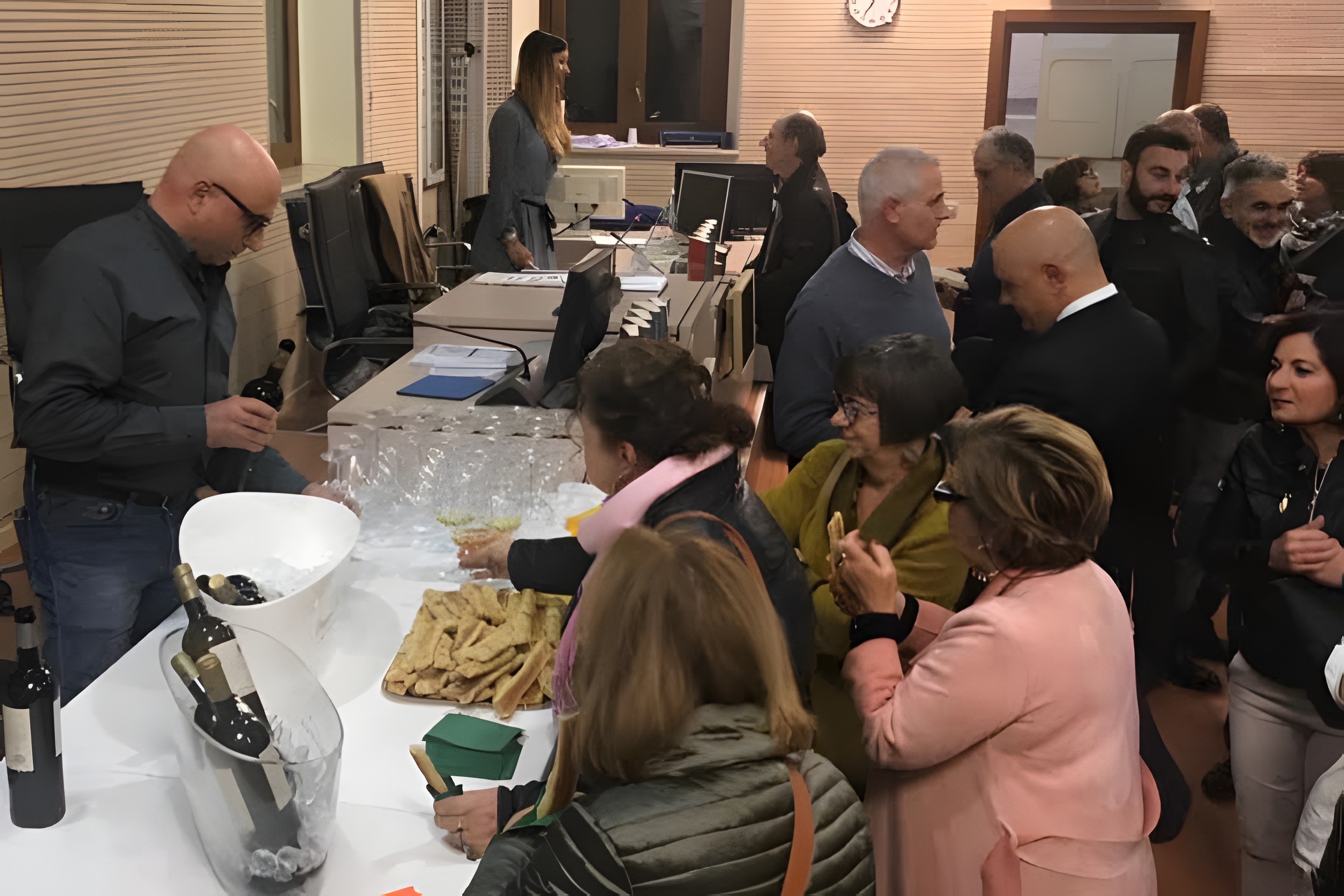
I attended the presentation of the beautiful essay "Gli eroi bevono vino" written by Professor Laura Pepe, lecturer in Ancient Greek Law at the University of Milan. The event was held in the council chamber of the III Municipality of Rome. The essay, which has a popular-science purpose, aims to investigate the most remote roots of wine in classical culture and in the customs of ancient Greek and Roman societies. At the end of the round table we tasted wine produced from "Greek" grape varieties by the Calabrian winery Caparra & Siciliani.
Until the time of Homer stories were told orally. Now the myths and anecdotes concerning men and gods are recorded in writing in the Iliade and the Odissea. In Greek society wine flows freely: from Ulisse ed Aiace sent by Agamemnon to Achilles as ambassadors, to the most famous episode of Ulisse getting Polyphemus drunk and blinding him in order to escape from the cave where he is imprisoned together with his travelling companions.
Of great importance were the Simposio and the Convivio, the banquet for the Greeks and for the Romans. The points of contact are mainly formal: for example in the use of klinai. The Greek Simposio is characterized by its high ritual nature and by the central role that wine assumes, served diluted with water. It is based on an ideal of equality among the diners, and wine is offered at a later stage, only after dinner has ended. In the Roman Convivio, food and wine are served together and there is a strict hierarchy among the participants. The Convivio marks the end of Roman frugalitas and the cena di Trimalchione is its emblem.
But the book also deals with the public wine festivals, both Greek and Roman: from the Greek Antesterie and Dionisie to the Roman Liberalia and Baccanali. The Antesterie, like the Dionisie, are celebrated in honour of the god of wine and madness. The former last three days, filled with rituals: the opening of the barrels, the day of the jugs and the day of the pots. In the latter, theatrical performances were central. For the Romans, Libero is the god of the seed, a vital and procreative force marking a man's passage into adult life. Later Libero becomes Bacco and in his honour the Baccanali are held, which over time degenerate until they are banned for reasons of public order. From private banquets to public festivals, women remain in the background, especially those belonging to the aristocracy. Except on the day of the festa della Bona Dea, a wholly female event in which men are banned and women drink wine and can behave with absolute freedom. As men usually do.
In any case, wine for both Greeks and Romans is considered the alcoholic drink worthy of a civilised people. Not so birra, regarded as the drink of barbarians. A kind of historical double standard, considering that the so-called barbarians – the peoples of Thrace or Asia Minor for the Greeks, the Germanic peoples for the Romans – thought the same things about the wine consumed by Greeks and Romans.
But wine also finds a place in ancient law. Although there is evidence of attempts at exculpation for actions contra legem carried out under conditions of intoxication or drunkenness, generally crimes committed were sanctioned both socially and legally. Starting from the Centauri and Ciclopi, who as teetotallers coming into contact with wine could not help but get drunk – adopting inappropriate or criminal behaviour – moderation in wine consumption was generally accepted. And even if certain categories of wine-related offences were regulated differently from today's law, the attempt to excuse oneself for committing a crime under the influence of alcohol was not entertained.
The last aspect addressed by the book is the close connection of wine to eros in the classical age, both as regards the role of women and the practice of pederastia. As already mentioned, women's participation in public festivals and private gatherings is marginal, with exceptions. Even if at late-Roman banquets women waited for their husbands to get drunk in order to act undisturbed with their lovers. Pederastia, on the other hand, was widely practised, and in Greek society even encouraged through certain rites that marked a boy's entry into adult life.
At the end of the debate, the Calabrian wine estate Caparra & Siciliani was introduced, represented by Gianni Caparra. The estate counts 200 hectares of vineyard producing nearly one million bottles in the territory of Cirò. Two wines were tasted, made from grape varieties of Greek origin – highly probable for the Gaglioppo and certain for the Greco: Volvito (Gaglioppo) and Curiale (Greco 85%, Chardonnay).
Let us move on to the tasting notes for the first of the two wines.
Cirò Rosso Classico Superiore Volvito 2015
From pure Gaglioppo grapes, aged for 8 months in used barriques. The colour displayed in the glass is typically varietal: lightly concentrated garnet, slightly faded at the rim. Swirling the glass it forms dense, tight arches, with a slowly descending drop; a full-bodied wine. The olfactory spectrum, predominantly fruity, nonetheless highlights a delicate Mediterranean aromaticity. Notes of ripe cherry, plum, cassis and blueberry are joined by aromatic herbs of timo, then sweet spices, leather, a light toastiness and liquorice on the finish. The elegant palate confirms the good structure with fine minerality, vivid freshness and a composed tannin well balanced by a well-integrated alcohol (14%). Persistent, the oral cavity is pervaded by a compact balsamic quality and it closes coherently with an aftertaste of liquorice root.
Already approachable, this wine can nonetheless express its best over the coming years. Best paired with meat-based preparations or also worth trying throughout a full meal. We could not have concluded our lovely afternoon any better than with this wine, an expression of the enology of Magna Grecia.


What do you think?
Log in to leave a comment